
Starting in the twelfth century, Jewish mysticism was called “Kabbalah,” or “tradition.” One of the most important kabbalistic innovations was to give the Torah an esoteric interpretation.
In order to explain the inner workings of the universe there emerged a new religious language complete with new symbols. These were necessary in order to convey the new understanding of God and the operation of the universe.
Ein Sof of the Kabbalah – The Tree of Life
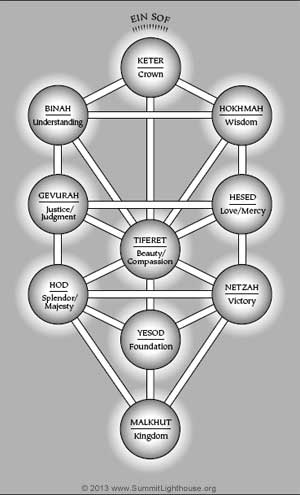 The most important of these symbols is Ein Sof, God, the unmanifest and unknowable.
The second of these is sefirot, a plural noun. The sefirot are the ten aspects of God’s being that manifest from Ein Sof.
The Hebrew names of God associated in Kabbalah with the ten sefirot, divine emanations of God are:
Adonai, “Lord” (Malkhut), pronunciation: ah-doh-NIE (ie as the i in high)
Shaddai, “Almighty,” pronunciation: shah-DIE
El Hai, “Living God” (Yesod), pronunciation: ehl khie. (kh as in German buch or Scottish loch. Place tongue in position for sounding the letter k, but release the breath in a stream as in pronouncing an h)
Elohim Tzevaot, “God of hosts” (Hod), pronunciation: ehl-oh-HEEM tz vah-OHT
YHVH Tzevaot, spoken Adonai Tzevaot, “Lord of hosts” (Netzah), pronunciation: ah-doh-NIE tz vah-OHT
YHVH, spoken Adonai (Tiferet), pronunciation: ah-doh-NIE (ie as the i in high)
Elohim, “God” (Gevurah), pronunciation: ehl-oh-HEEM
El, “God” (Hesed), pronunciation: ehl
YHVH, spoken Elohim (Binah)
Yah, “the Eternal” (Hokhmah), pronunciation: yah
Ehyeh Asher Ehyeh, “I AM THAT I AM” (Keter), pronunciation: eh-heh-YEH ah-SHAIR eh-heh-YEH
Read #1 in the Names of God series: Mantra Yoga.
The above article is excerpted from Kabbalah: Key to Your Inner Power by Elizabeth Clare Prophet.
 Enjoy the Names of God set to the music of the spheres.
Buy online: Music CD: Come, Holy Dove! Mystical Union through the Names of God

Sorry, comments are closed for this post.